Instead of manually chasing shirt sizes, artwork approvals, and delivery updates, build your Grunt Style custom bulk order around a locked employee roster, written supplier confirmation, and a documented handoff to each location. This 2026 workflow takes you from an internal uniform brief to employee distribution without treating an inquiry as an accepted production order.
- Plan your Grunt Style custom bulk order around confirmed requirements, approved artwork, and an employee size roster.
- Confirm custom production scope before collecting final uniform commitments or announcing a company-wide launch.
- Assign one approval owner and reconcile every received garment against the accepted order.
- Keep the approved specification and issue log together for future employee uniform requests.
Why this matters
Grunt Style patriotic apparel is best suited to teams seeking patriotic or military-themed casual clothing. That category fit does not establish that a particular garment accepts company decoration or meets your workplace requirements.
Start with Grunt Style to understand the apparel category, then separate your company's requirements from the supplier's written commitments. A retail product listing is not a custom-production agreement.
Your 2026 rollout needs two distinct approvals: permission to buy the agreed garments and permission to issue them for the intended work. Keep those decisions separate, especially when a company has customer-facing staff, field crews, and office employees.
Do not announce the uniform launch until the production scope and delivery plan are confirmed. A target date belongs in your brief; an agreed date belongs in the accepted order record.
Before you start
- Access and ownership: Have access to your purchasing approval process, a shared roster, company artwork you are authorized to use, and a designated supplier contact. Assign 1 approval owner to consolidate decisions rather than sending conflicting instructions.
- Employee requirements: Gather garment preferences, work locations, size selections, role requirements, and the intended first-wear date. Use an employee identifier rather than collecting unrelated personal information.
- The gotcha: Confirm that the proposed custom work is accepted before treating any retail garment as a decoration option. Ask which garments, artwork placements, file formats, quantities, approval steps, and fulfillment arrangements the supplier will accept for your specific request.
The bold field names below are suggested labels for your own worksheet, not names of buttons or fields on a supplier website. This workflow uses shared records and written approvals; it does not require an assumed ordering portal or integration.
Uniform brief and rollout model
Define the uniform brief
- Create a shared document titled 2026 Uniform Brief. Record Purpose, Workplace Requirements, Requested Garment, Requested Decoration, First-Wear Target, and Approval Owner.
- Describe what employees actually do while wearing the uniform. Include movement, layering, customer contact, and any employer-required protective equipment.
- Define the visual standard in plain language: permitted colors, acceptable messaging, company identification, and whether employees need different fits.
- Choose a rollout model before requesting a proposal. Use the table below to match distribution responsibility to your organization.
| Rollout model | Best for | Advantage | Trade-off |
|---|---|---|---|
| Central receiving | A team distributing from one controlled location | Keeps receiving checks and issue records together | Your team handles sorting and onward distribution |
| Site-by-site rollout | A company with separate operating locations | Makes each location responsible for its handoff | Requires consistent instructions and local accountability |
| Pilot before expansion | A team with unresolved fit or workplace questions | Lets employees assess an accepted sample arrangement before wider commitment | Adds an internal decision stage before expansion |
These are internal operating models, not claims about supplier shipping services. Confirm the fulfillment arrangement separately.
Expected result: You have a written definition of the uniform, an accountable decision-maker, and a distribution model. Anyone reviewing the brief can identify what the order must accomplish and what remains subject to supplier confirmation.
Keep safety approval separate
Patriotic casual clothing is not a substitute for required protective clothing. If a role requires high-visibility, flame-resistant, or other protective apparel, have your workplace safety owner verify the applicable garment requirements before purchasing.
Do not approve a shirt for a restricted work area because its color looks suitable. Record the required documentation in Workplace Requirements, and keep that decision separate from artwork approval.
Employee roster and order specification
Build the size roster
- Create Employee ID, Location, Garment Choice, Size Selection, Requested Quantity, and Employee Confirmed columns in your shared worksheet.
- Ask each employee to select a size for the exact proposed garment using its current sizing information. Do not transfer a size automatically from an unrelated shirt.
- Resolve incomplete entries privately. Mark unresolved selections as pending rather than guessing sizes to complete the worksheet.
- Set an internal roster cutoff. Save an approved copy, then record later changes separately instead of silently overwriting the submitted version.
Expected result: Every intended recipient has a confirmed selection, and the submitted quantities can be traced back to the roster.
For a 2026 company-wide rollout, different garment cuts deserve separate entries even when employees select the same letter size. The garment choice and the size selection together define the request.
If employees need help making that choice, use the guide to finding your size when buying patriotic apparel online. Keep the final selection attached to the exact garment under consideration.
Create the order matrix
Group the confirmed roster by garment, color, fit, size, and destination. This summary is your Order Matrix; the employee roster remains the record of who receives each item.
Maintain 3 linked records: the employee roster, the order matrix, and the issue log. Give them the same internal project reference so a later correction does not become a search through unrelated files.
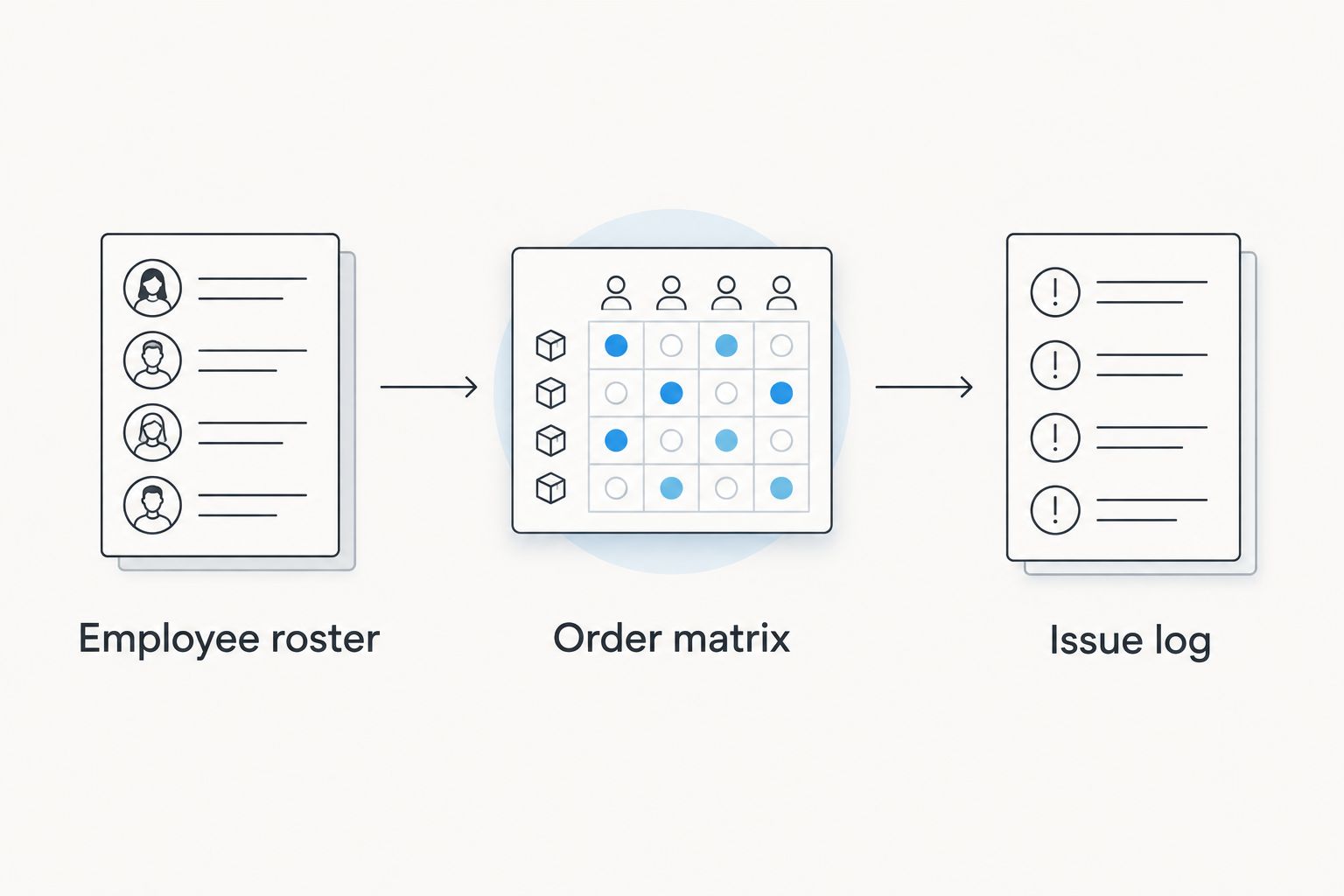
Before submission, reconcile each grouped quantity against the employee entries behind it. Record any proposed spare garments as a separate, approved line rather than hiding them inside employee totals.
Expected result: Purchasing has a clear quantity summary, while distribution retains an employee-level record. The two documents agree without exposing unnecessary employee details to everyone involved.
Supplier confirmation and production approval
Submit a complete request
- Send the uniform brief, order matrix, requested artwork, and target date through the supplier contact channel you have verified. Identify one person authorized to send consolidated instructions.
- Ask for written confirmation of the accepted garments, customization scope, artwork requirements, quantity requirements, and fulfillment arrangement.
- Request the proposed approval sequence and schedule dependencies. Distinguish artwork review, production release, dispatch, receiving, and employee distribution in your internal plan.
- Compare the response with your brief. Record every difference under Open Decisions, including proposed substitutions or changes to the requested decoration.
Expected result: You have either a confirmed path to an order or a clear list of unresolved requirements. An unanswered request stays an inquiry, not an approved purchase.
For a Grunt Style custom bulk order, written acceptance of your specific request is the purchasing gate. Do not infer custom-production terms from a retail listing, a related article, or a previous order.
Keep the supplier-facing request focused. Employee names are unnecessary when a grouped size matrix and destination information adequately describe the order.
Approve the exact specification
- Review any supplied artwork proof against the approved brief. Check company spelling, wording, placement, orientation, and the garment identified in the proof.
- Ask how decoration dimensions and placement will be documented. Do not treat an on-screen mockup as a physical measurement unless the specification establishes that relationship.
- Reconcile the proposed order quantities with your locked matrix. Resolve substitutions and unanswered questions before release.
- Save the accepted specification and the approval message together. Record Approved By, Approval Date, and Approved Version in your worksheet.
Expected result: The release record identifies exactly what your company approved. It does not depend on someone remembering which attachment was final.
Use 2 approval checkpoints in your internal process: specification approval before release and receiving acceptance before distribution. These are recommended controls for your company, not stated supplier policies.
Do not authorize production against an unresolved proof. If the requested first-wear date no longer fits the confirmed schedule, change the internal rollout plan rather than assuming production will accelerate.
Receiving and employee handoff
Reconcile the delivery
- Assign a receiving owner before the shipment arrives. Give that person the accepted order matrix and specification, not an earlier draft.
- Count the received garments by the same categories used in the order matrix. Record Expected Quantity, Received Quantity, and Difference for each line.
- Check garment identity, marked size, and decoration against the accepted specification. Record discrepancies with clear photographs and the relevant order reference.
- Separate disputed items from garments cleared for distribution. Send the discrepancy record through the agreed supplier contact channel and request written next steps.
Expected result: You know what arrived, what matches the order, and what needs resolution. Distribution staff are not discovering discrepancies while employees wait.
For your 2026 receiving record, distinguish a marked-size mismatch from an employee fit concern. The first compares the garment with the order; the second compares the garment with the employee's needs.
Issue against the roster
- Sort accepted garments by location and employee identifier. Keep unresolved items outside the distribution queue.
- Record Issued Quantity, Issue Date, Recipient Confirmation, and Open Issue in the issue log.
- Give employees the care instructions supplied with the garment. Do not substitute an invented universal wash temperature or drying rule.
- Close each roster entry only after the employee receives the assigned garments or an exception is documented.
Expected result: Every accepted item has a recorded destination, and every employee request has a visible status. A delivered shipment is no longer being mistaken for a completed rollout.
Repeat the workflow when staffing changes
Best for: teams adding employees or replacing issued garments. Use a change-request queue rather than reopening the original roster every time someone joins the company.
Create Request Reason, Employee ID, Specification Version, Garment Selection, and Approval Status fields. Check each request against the approved uniform standard before grouping it with other requests.
This approach preserves a consistent specification, but it adds an approval step for exceptions. Keep that trade-off deliberate: speed should not silently change the company uniform.
When a repeat purchase needs supplier confirmation, send a fresh request referencing the approved specification. Do not assume an earlier production arrangement, garment selection, or schedule applies indefinitely.
For the remainder of 2026, retain superseded specifications as read-only records. Mark the active version clearly so new employees do not receive garments selected against an outdated brief.
Troubleshooting
Employee totals do not match the order matrix
Rebuild the summary from the locked roster and check for duplicate employees, unconfirmed entries, and separately approved spares. Do not adjust the grand total without finding the underlying mismatch.
Different people approved different artwork files
Stop the release process and identify the authorized approval owner. Consolidate feedback into one version, withdraw conflicting instructions in writing, and request confirmation of the version being used.
The confirmed schedule misses your launch target
Move the first-wear date or arrange an internally approved temporary dress standard. Separate the supplier's confirmed commitments from your company's receiving and distribution tasks before setting a replacement date.
Received garments differ from the accepted specification
Hold the affected items, document the difference, and contact the supplier with the order reference. Do not alter disputed garments or promise employees a particular remedy before it is agreed.
An employee needs a different fit after issue
Log the fit concern separately from an order discrepancy. Review the garment's sizing information and the applicable order terms before promising a replacement, return, or exchange.
Customize your workflow
Expand the same records to include department requirements, seasonal layers, and employee onboarding. Keep each addition tied to the approved specification rather than letting individual managers create competing uniform standards.
If the visual direction is still unsettled, start with choosing patriotic apparel for a veteran-owned business uniform. Set the dress standard before collecting final garment selections.
FAQ
How do I start a Grunt Style custom bulk order for my company?
Start with a written uniform brief, a grouped size matrix, and a verified supplier contact. Confirm acceptance of your requested custom work before treating the inquiry as an order.
Can I add my company logo to any retail shirt?
Do not assume a retail shirt can be included in a custom-production request. Ask the supplier to confirm the accepted garment and decoration scope in writing.
What information should I collect from employees?
Collect an employee identifier, location, exact garment choice, size selection, and requested quantity. Keep unrelated personal information out of the ordering worksheet.
Should I use central receiving or send uniforms to each location?
Use central receiving when you want one controlled inspection and distribution record. A site-by-site rollout assigns local responsibility but requires consistent receiving instructions; confirm the shipping arrangement separately.
How long should I allow for a company-wide uniform rollout?
Build the rollout around the supplier-confirmed schedule and your internal approval, receiving, and distribution tasks. Do not treat a general shipping estimate as a custom-production commitment.
What if the delivered sizes do not match my order?
Compare the marked sizes with the accepted order matrix and document each mismatch. Separate affected garments and request written next steps from the supplier.
Can patriotic shirts replace required jobsite safety clothing?
Patriotic styling does not establish compliance with workplace protective-clothing requirements. Have your safety owner verify the exact garment against the requirements for the role.
One last thing
A uniform rollout ends with employee receipt, not shipment delivery. Keep the project open until each roster entry is issued or has a documented exception. That final reconciliation gives your next order a usable starting point instead of another round of guesswork.