Half the "veteran owned" tags on shirts and hoodies right now are marketing copy, not fact. If you want your money going to a company with actual military ties in 2026, you need a five-minute verification process, not a gut feeling about the flag graphic on the label.
- Verified veteran owned clothing brands carry a VOSB or SDVOSB registration number you can look up on SAM.gov, not just a logo.
- A brand naming a specific charity and a specific percentage beats vague 'support our troops' language every time.
- Grunt Style's patriotic apparel lineup is a reference point for military-themed design with real production behind it, not stock clip art.
- Any brand that can't name a founder, a unit, or a service branch on its About page in 2026 is a reseller, not a veteran business.
- Reverse-image search the flag or eagle graphic before you buy — recycled clip art is the single biggest tell.
Why this matters
The patriotic apparel category exploded after 2020, and print-on-demand shops noticed. Slapping an eagle on a hoodie costs nothing and the margin on a $30 tee with a flag print is real money, which is exactly why so many brands lean on "support our troops" messaging with zero connection to service members.
The federal government actually tracks this. Veteran-Owned Small Business (VOSB) and Service-Disabled Veteran-Owned Small Business (SDVOSB) status are verified designations administered through SAM.gov, and they require at least 51% ownership and day-to-day control by a veteran. That's a standard the VA audits directly — it's not a badge a brand can just print on a hang tag.
Knowing how to check this in 2026 protects two things: your money, and the credibility of brands that actually earn the designation.
What you'll need
- 10 minutes and the brand's website open in a tab
- Access to SAM.gov to search the entity registration
- A reverse image search tool (Google Lens or TinEye) for logo and graphic checks
- The brand's About page, return policy page, and any "our story" content
- A Grunt Style product page or comparable patriotic apparel line open as a reference point for design quality
The steps
1. Search the business name on SAM.gov
This is the step most shoppers skip and the one that matters most. SAM.gov is the federal System for Award Management, and it's where VOSB and SDVOSB certifications actually live. Type the company's legal name — not just the storefront brand — into the entity search.
If the business shows up with an active SDVOSB or VOSB designation, that's verified. If it doesn't, the brand may still be veteran-founded without the federal certification, which isn't disqualifying on its own — but it means you're taking their word for it, not a government registry's.
Common mistake: searching the storefront name instead of the legal entity name listed in the site's footer or terms of service.
2. Read the About page for names, not slogans
A real veteran-connected apparel brand names its founder, their branch of service, and usually their unit or years served. Vague copy like "founded by veterans, for veterans" with no name attached is a red flag in 2026 — it costs nothing to write and nothing to fact-check.
Look for specifics: rank, deployment location, discharge status. Brands with nothing to hide put this front and center, not buried three clicks deep.
3. Check where the product is actually made
A patriotic t-shirt printed and shipped from overseas isn't automatically fake, but a brand that hides its manufacturing location while draping itself in American flag branding is worth a second look. Scroll to the footer and the shipping policy page — legitimate brands usually state country of origin somewhere, even if it's just on the product tag photo.
4. Verify the charity claim with a number
"A portion of proceeds supports veterans" means nothing without a percentage and a named organization. Compare that language to a brand stating something concrete — a specific nonprofit, a specific dollar amount per unit sold, or an annual giving report. If a company can't tell you where the money goes, assume it stays with the company.
5. Reverse-search the graphics
Run the eagle, flag, or skull-and-stars design through Google Lens. Recycled clip art bought from a stock graphics marketplace shows up on dozens of unrelated storefronts within seconds. Original screen prints and embroidery work — the kind you'd see on a Culpeper Minutemen 1775 flag design or a Warriors Never Die graphic — don't duplicate across ten random Shopify stores.
Why it matters: this single check filters out most drop-shipped "patriotic" brands in under a minute.
6. Check military discount verification
Brands with genuine ties to the veteran community almost always run their military discount through a third-party verification service like ID.me or SheerID rather than an honor-system promo code. It's a small detail, but it signals the company built actual infrastructure around serving that customer base instead of bolting a discount code onto checkout.
7. Read reviews for community language, not just star ratings
Five-star reviews with generic phrasing ("great shirt, fast shipping") tell you nothing. Reviews mentioning specific units, deployments, or events — a unit reunion, a Memorial Day ruck, a retirement ceremony — tell you the customer base is actually the military community the brand claims to serve.
8. Compare product quality against a known reference
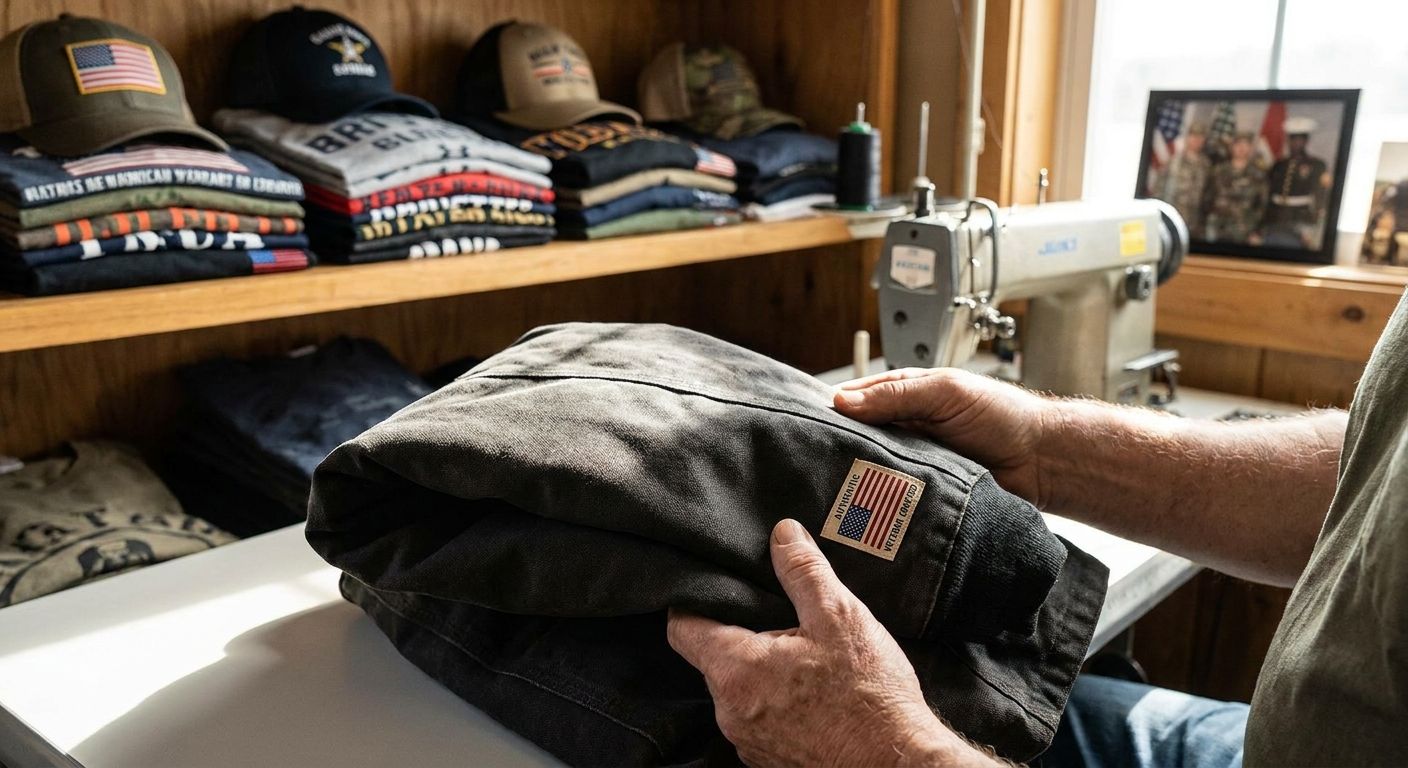
Once you've checked the paperwork, check the product. Heavier cotton weight, reinforced stitching at stress points, and print durability after multiple washes separate a real apparel operation from a print-on-demand reseller. Use an established patriotic apparel line as your benchmark for what quality construction feels like before you commit to a lesser-known name.


Troubleshooting
- Brand says "veteran owned" but SAM.gov shows nothing: treat the claim as unverified marketing until the company provides a registration number or names the founder directly.
- "Portion of proceeds" with no percentage listed: email the company and ask for the exact figure. A real charitable partner has an annual report or a stated percentage on file.
- Country of origin is nowhere on the site: check the product tag in customer photos on the reviews page — brands hiding this information usually still get caught in their own review section.
- Same flag graphic across ten different storefronts: that's a licensed stock design, not proprietary artwork. Move on.
- All reviews are five stars with no verified purchase badge: cross-check the brand name on a third-party review platform like Trustpilot before trusting the on-site testimonials.
- No social media activity tied to actual events: a brand engaged with the veteran community posts about specific reunions, 5Ks, and ceremonies — not just product drops.
Tools and resources
- SAM.gov entity search for VOSB/SDVOSB verification
- Google Lens or TinEye for reverse-image graphic checks
- Better Business Bureau profile lookup for complaint history
- How to care for flag print apparel so colors don't fade — once you've verified a brand, this covers keeping the print looking sharp past year one
- A comparable patriotic apparel line to check fabric weight and stitching against before you buy from an unfamiliar name
What to do next
Once you've run a brand through this checklist, build your wardrobe around the ones that pass. How to build a patriotic wardrobe capsule walks through picking pieces that actually get worn year-round instead of sitting in a drawer after the Fourth of July.
FAQ
What makes a clothing brand officially veteran owned in 2026?
An officially veteran owned clothing brand carries a VOSB or SDVOSB certification through SAM.gov, requiring at least 51% ownership and daily control by a veteran. Without that registration, 'veteran owned' is an unverified marketing claim, not a legal designation.
Is SDVOSB different from VOSB?
Yes. SDVOSB (Service-Disabled Veteran-Owned Small Business) requires the veteran owner to have a service-connected disability rating, while VOSB has no disability requirement. Both are verified through SAM.gov.
How do I check if a brand's military discount is real?
Real military discounts run through third-party verification services like ID.me or SheerID rather than an honor-system promo code. If checkout never asks for ID verification, the discount is likely unmonitored.
Can a brand be patriotic-themed without being veteran owned?
Yes, and that's not automatically a problem. Plenty of apparel companies design military-themed and patriotic apparel without veteran ownership — the issue is only when a brand falsely claims veteran ownership it doesn't have.
Why do reverse image searches catch fake patriotic brands?
Recycled stock graphics appear across multiple unrelated storefronts within seconds of a reverse search. Original screen-print or embroidery work tied to one brand doesn't duplicate that way, which makes this one of the fastest authenticity checks available.
Does a charity donation claim need a specific percentage?
A credible claim states an exact percentage or dollar amount and names the receiving organization. Vague phrasing like 'a portion of proceeds supports veterans' with no figure attached is unverifiable and common among brands with no actual giving program.
What's the fastest way to spot a print-on-demand patriotic brand?
Check fabric weight, stitching at seams, and whether the same design shows up on other unrelated stores. Print-on-demand operations typically use lighter blanks and generic graphics licensed from stock marketplaces.
Should I trust on-site reviews alone before buying patriotic apparel?
No. Cross-check the brand on a third-party platform like the Better Business Bureau or Trustpilot, since on-site review sections can be curated or lack verified-purchase badges.
One last thing
SDVOSB certification isn't a one-time application — the VA re-verifies ownership and control periodically, and businesses get delisted if a veteran founder steps back from daily operations. That's the detail most shoppers never check: a brand that had the designation in 2022 might not hold it in 2026. Always search the current SAM.gov record, not an old press release.