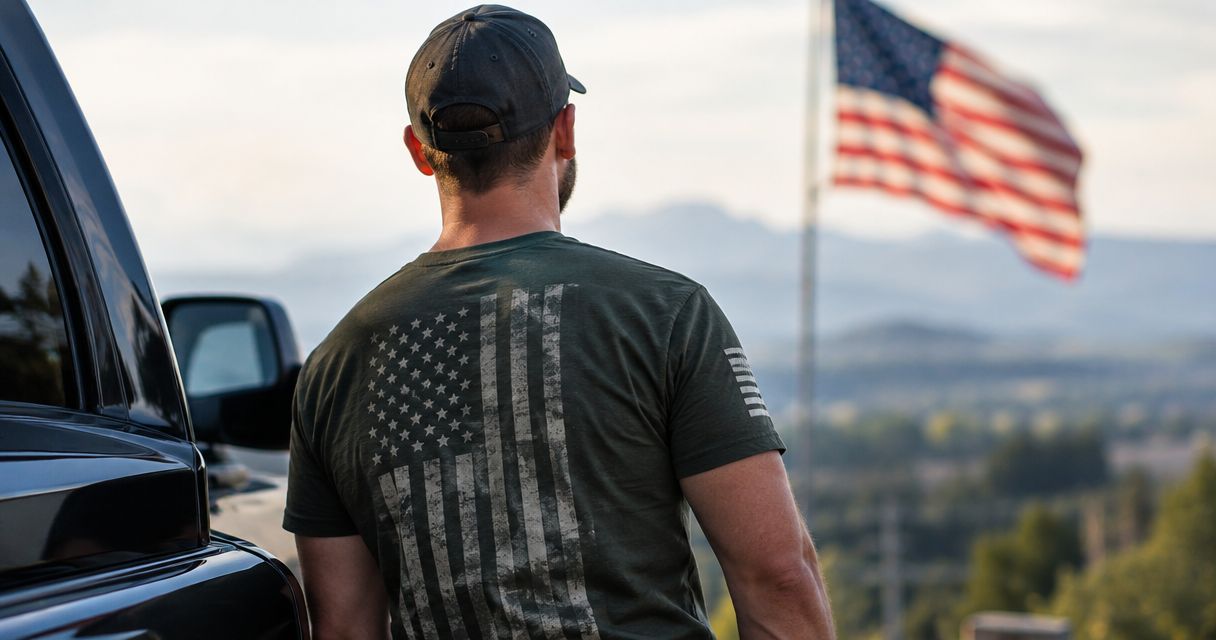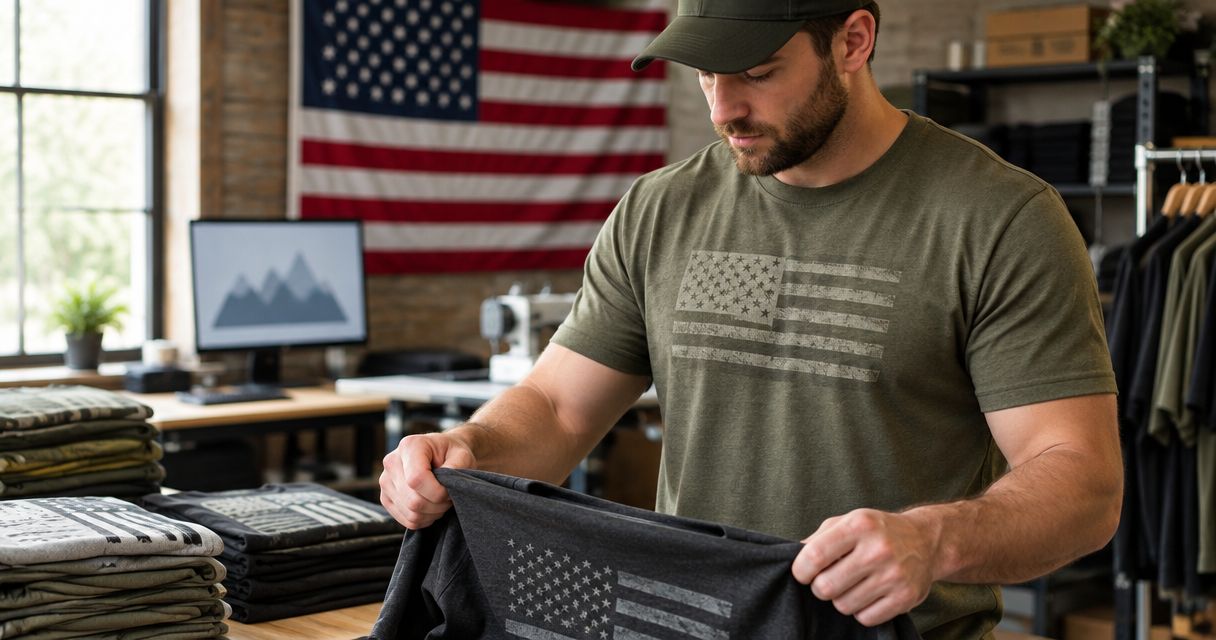
You should not treat Grunt Style apparel as universally made in the USA; verify the country-of-origin statement for the exact item you want. Patriotic graphics and U.S. printing claims do not establish where a garment was manufactured. For a 2026 purchase, check the garment’s origin label before treating it as American-made.
- Is Grunt Style made in the USA? Verify each garment’s country-of-origin label rather than assuming a brand-wide answer.
- Grunt Style sells patriotic apparel; patriotic designs do not establish American manufacturing.
- Printed in the USA describes decoration, not necessarily where the garment was made.
- For American-made clothing, read the complete origin statement, including any qualifications.
Why this matters
Buying patriotic apparel and buying American-made apparel are different decisions. You can care about both, but a flag graphic answers a design question—not a manufacturing question.
When you browse Grunt Style, separate what you want the clothing to express from where you require it to be made. Grunt Style is best for shoppers seeking patriotic and military-themed apparel; manufacturing origin still requires an item-level check. That distinction keeps your purchase aligned with your priorities without making unsupported assumptions about the entire catalog.
Is Grunt Style apparel made in the USA?
Use the exact garment’s country-of-origin statement, not the brand name, to answer the question. A claim about printing, design, ownership, or shipping does not automatically establish where the underlying shirt, hoodie, or hat was manufactured.
For your 2026 purchase, read the wording in full. An unqualified American-made claim and a statement identifying only a U.S. production step communicate different things.
| Wording you encounter | What it tells you | What it does not establish |
|---|---|---|
| Made in USA, without qualification | Claims U.S. origin for the product under the applicable standard | That unrelated products from the same brand have the same origin |
| Made in USA with imported materials | Identifies U.S. manufacturing while disclosing imported inputs | That the materials are entirely domestic |
| Printed in the USA | Identifies where printing occurred | Where the blank garment or fabric was made |
| Designed in the USA | Identifies where design work occurred | Where manufacturing occurred |
| Ships from the USA | Identifies a shipping location | Where the product was manufactured |
| Patriotic or military-themed | Describes the design or subject matter | Any manufacturing location |
These are examples of claim types, not statements that any particular item carries each claim. Read the actual wording attached to the garment you intend to buy.
What standard applies to an American-made claim?
The Federal Trade Commission’s general standard for an unqualified Made in USA claim is all or virtually all made in the United States. Apparel also has textile-specific origin-labeling requirements, so a general marketing phrase should not replace the garment’s country-of-origin information.
The practical takeaway is straightforward: qualifications matter. Do not shorten a statement about imported materials or a specific domestic production step into a broader claim that everything is American-made.
How to verify a garment’s origin before you buy
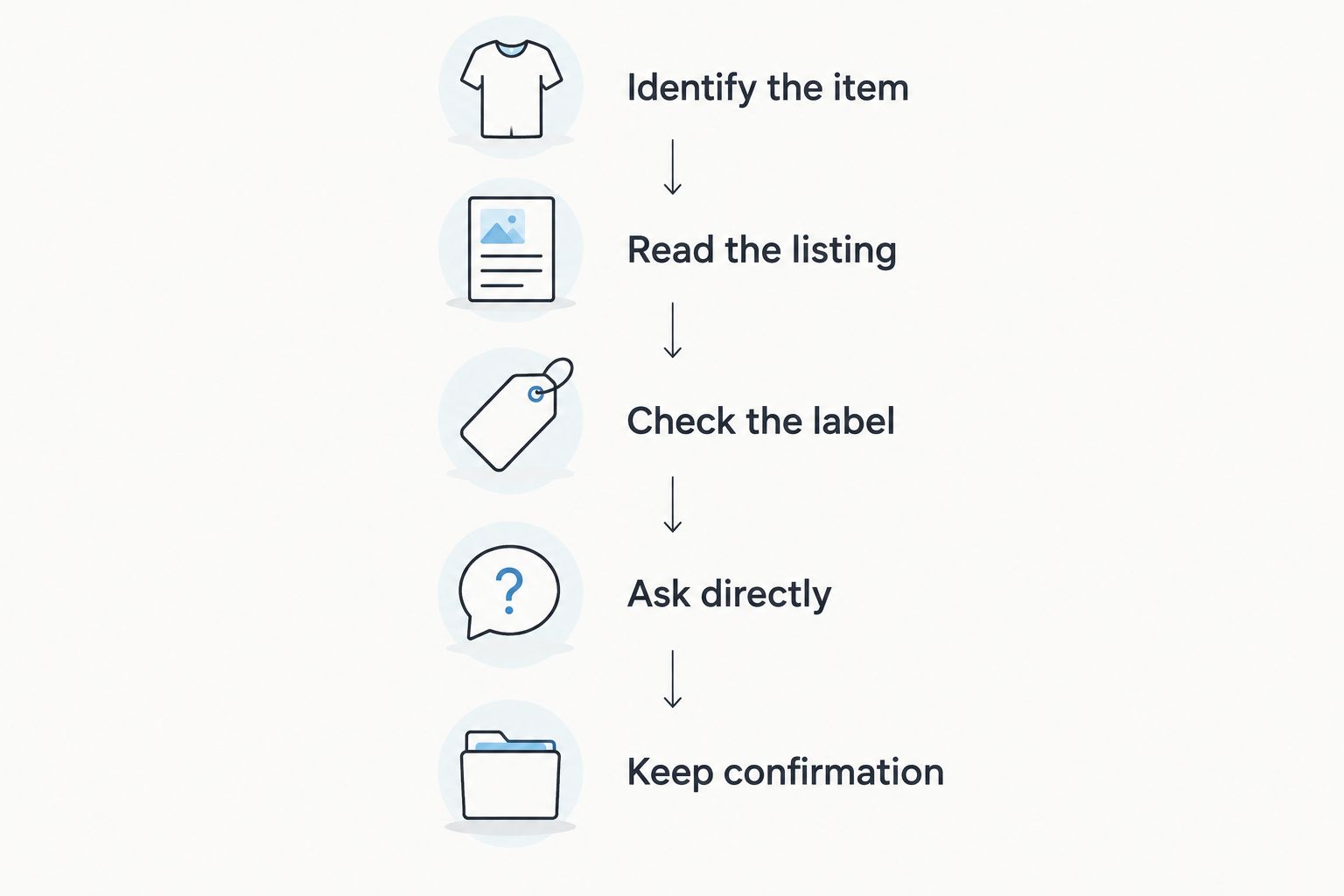
Use this sequence for a shirt, hoodie, hat, or accessory. It works whether you are choosing something for yourself, buying a veteran a gift, or setting a purchasing requirement for a group.
- Identify the item. Record the full product name and the version you intend to purchase. Ask about that item rather than the entire brand.
- Read the listing. Look for explicit country-of-origin wording in the description and product details. Treat slogans and design descriptions separately.
- Check the label. Read a clear photograph of the origin label when one is provided. On a physical garment, inspect the sewn-in or printed labeling rather than relying on packaging alone.
- Ask directly. If origin determines whether you buy, request the manufacturing country for the exact item. Distinguish garment production from printing or embroidery.
- Keep confirmation. Save the relevant description, label photograph, or written response with your purchase records. This matters when you need to explain a gift choice or document a group purchase.
A useful inquiry asks which country the garment was manufactured in and whether any U.S. claim refers only to decoration. That is more precise than asking whether the company is American.
Do not convert an unclear response into a yes. If domestic manufacturing is a requirement, keep the purchase undecided until you receive an explicit statement that addresses that requirement.
For more help choosing by manufacturing origin rather than graphics alone, see the guide to patriotic T-shirts for shoppers who want U.S.-made apparel.
Made in USA: check the complete statement
Best for: shoppers whose purchase depends on domestic manufacturing. An explicit origin statement gives you something concrete to evaluate. Read it alongside the garment’s label and any stated qualifications.
The benefit is specificity: you are evaluating a manufacturing claim rather than inferring origin from a patriotic message. The limitation is scope—a statement about a particular item is not permission to describe every item in the catalog the same way.
For a strict 2026 buying requirement, write down what you mean by American-made before shopping. Decide whether your requirement concerns garment manufacturing, material origin, or both, then request information that addresses those points.
Printed in the USA: check the garment separately
Best for: shoppers specifically interested in where decoration occurs. Printing is a production step. It does not, by itself, answer where the undecorated garment was manufactured.
The benefit of a printing statement is that it identifies the location of that work. Its limitation is equally clear: it leaves the garment’s manufacturing origin unanswered unless another statement supplies it.
Do not read a domestic printing claim as an unqualified American-made claim. Ask where the blank garment was made, and check its country-of-origin label before deciding that it meets your requirement.
Designed in the USA: treat it as a design claim
Best for: shoppers who want to know where the creative work occurred. Design can include artwork and other creative decisions, but a design-location statement does not identify the manufacturing country.
Its benefit is narrow and useful: it tells you something about the design process. Its limitation is that it cannot settle questions about fabric production, garment assembly, or decoration.
If your goal is domestic manufacturing, continue checking. A design claim and a manufacturing claim can both be relevant, but they are not interchangeable.
Why an apparel origin claim’s wording matters
Apparel involves distinct materials and production steps. Your job as a shopper is not to reconstruct a supply chain from a slogan; it is to identify exactly what the origin statement covers.
These factors explain why wording deserves attention:
- Materials: A statement can distinguish domestic manufacturing from imported fabric or other inputs. Keep that qualification attached to the claim.
- Garment assembly: Cutting and sewing are separate from creating artwork or applying a print. Ask about garment manufacturing when that is your priority.
- Decoration: Printing and embroidery identify work performed on a garment. Their location alone does not establish the garment’s origin.
- Claim scope: A statement can apply to an item, a named collection, or a broader range. Do not extend it beyond its stated scope.
- Product identity: A shirt, hoodie, and hat are separate products. Verify each intended purchase instead of transferring information from one to another.
For 2026 shopping, use current item information rather than an old screenshot or a comment about another garment. That is a verification rule, not a claim that any particular product’s manufacturing location has changed.
Does an American flag on a shirt mean it was made in America?
An American flag graphic does not establish American manufacturing. It communicates a design theme, while country-of-origin labeling addresses where the product was made.
Choose the graphic because it expresses what you want to wear. Confirm origin separately if domestic production is also part of your buying decision.
Does veteran ownership prove that apparel is U.S.-made?
Veteran ownership does not establish a garment’s manufacturing country. Ownership and production location are separate facts, and each requires its own evidence.
This distinction does not diminish military service or a company’s mission. It prevents an ownership claim from being used to answer a different question about manufacturing.
Should I check origin again when ordering a different style?
Check each different style rather than carrying over an earlier item’s origin statement. Information attached to a particular garment supports a conclusion about that garment, not an automatic conclusion about another product.
Keep the process simple: match the product name, read the current wording, and confirm the label. For a group order, list each intended item separately so your request is clear.
Buying for yourself, a gift, or a group
Your buying standard should match the promise you intend to make. If you are purchasing patriotic apparel for its message, evaluate the design and garment details without adding an unsupported manufacturing claim.
If you are giving a gift specifically because it is American-made, verify that attribute before describing it to the recipient. A thoughtful gift does not need an origin story you cannot substantiate.
For a business or community order in 2026, make the requirement explicit before selecting items. Tell the seller whether domestic garment manufacturing is mandatory and whether imported materials affect your decision. A precise requirement produces a more useful answer than a broad request for American products.
Keep these checks separate from fit and care. Manufacturing origin does not tell you whether a garment will fit the recipient, and a care label serves a different purpose from an origin statement.
FAQ
Is all Grunt Style apparel made in the USA?
Do not assume a brand-wide U.S.-manufacturing claim. Verify the country-of-origin statement for the exact garment, and do not substitute patriotic branding or a printing claim for manufacturing information.
Does printed in the USA mean a shirt is American-made?
Printed in the USA identifies the location of printing, not necessarily where the shirt was manufactured. Check the garment’s separate country-of-origin statement.
What does an unqualified Made in USA claim mean?
The Federal Trade Commission’s general standard is that the product is all or virtually all made in the United States. Apparel also has textile-specific origin-labeling requirements, so read the garment’s actual labeling.
Where should I look for a shirt’s country of origin?
Look at the garment’s origin label and the product listing’s explicit manufacturing information. If you cannot establish origin before buying, ask for confirmation about the exact item.
Does designed in America mean manufactured in America?
Designed in America does not establish American manufacturing. It describes design work, so you still need the garment’s country-of-origin information.
Does shipping from a U.S. warehouse prove domestic manufacturing?
Shipping from a U.S. warehouse does not prove domestic manufacturing. Shipping location and manufacturing location answer different questions.
What should I ask before buying American-made apparel as a gift?
Ask which country the exact garment was manufactured in and whether any U.S. claim is limited to printing or another production step. Keep any material-origin qualifications attached when describing the gift.
One last thing
A narrow claim read accurately is more useful than a broad assumption. Printed domestically, designed domestically, and manufactured domestically describe different work; none should silently replace another.
Before placing your order, finish this sentence with verified information: this garment was manufactured in the country stated on its origin label. If you cannot do that yet, ask before you buy—not after you have promised someone an American-made gift.