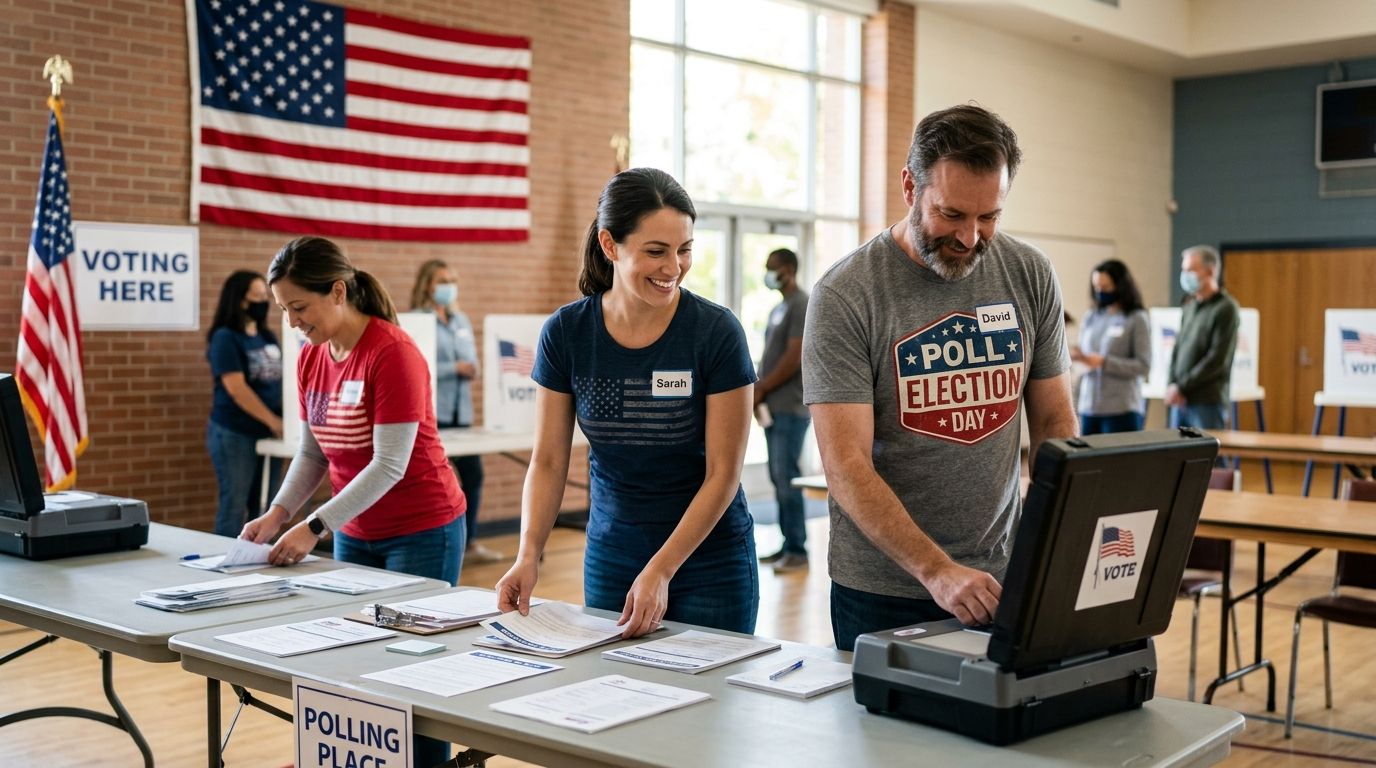
Patriotic shirts for election day poll workers are plain, nonpartisan flag and USA-themed apparel worn during a 12- to 14-hour polling shift to signal civic pride without crossing electioneering rules. The bar here is stricter than a normal Fourth of July tee: no candidate names, no party branding, no ballot measure references — just the flag, the country, and the job in front of you.
- Plain flag tees like Grunt Style's Best Of America design clear most 2026 polling-place dress codes.
- Nonpartisan patriotic apparel avoids the electioneering bans states enforce near polling places, unlike candidate or party gear.
- A 12- to 14-hour shift needs breathable fabric, a layering piece, and a fit checked before Election Day morning.
- Skip hats or pins with any text if your county restricts logos at the check-in table — confirm first.
Why patriotic shirts matter for election day poll workers
Poll workers stand at the one place in the country where clothing gets read by hundreds of strangers a day. Most states run polls for 12 to 14 hours, often 6 a.m. to 8 p.m., and every voter who walks past the check-in table sees what you're wearing.
That scrutiny is different from what a police officer or their family deals with on a normal patriotic-apparel occasion. Poll workers can't wear anything that reads as campaign gear, even by accident — a shirt with a candidate's name, a party's logo, or a color combination tied to a specific race can get a worker sent home mid-shift.
The fix isn't skipping patriotic apparel — it's picking the plain, nonpartisan version and building a wardrobe that survives a full shift standing in a gym or a church basement. Grunt Style's plain flag and tribute designs are built around exactly that list of rules.
Check your state's electioneering dress rules first
Every state draws its own line on what counts as political apparel at a polling place, and poll worker dress codes usually run stricter than voter dress codes. The U.S. Supreme Court's 2018 ruling in Minnesota Voters Alliance v. Mansky confirmed states can ban political apparel inside polling places — but it left plain patriotic clothing that doesn't reference a candidate, party, or ballot measure untouched.
- Call your county election office before you buy anything for 2026
- Ask specifically about hats, buttons, and lanyards, not just shirts
- Get the rule in writing or a screenshot if it's posted online
- Confirm whether the rule covers just the building or the outdoor check-in line too
- Ask if early voting sites follow a different rule than Election Day precincts
Choose plain, nonpartisan patriotic designs
Stick to flag graphics, block-letter "USA," eagle imagery, or tribute designs that don't reference a party, a candidate, or a current political fight. A shirt that could plausibly show up at a backyard cookout is safer than one built around a live issue.
- Solid-color flag tees in navy, black, or grey
- American eagle or tribute-style graphics with no slogan attached
- Plain block-letter "USA" designs
- Avoid anything referencing a specific election, candidate, or measure
- Skip novelty or joke text shirts — a poll worker isn't the audience for it
Dress for a 12+ hour shift, not a rally
A shirt built for a tailgate lasts four hours. A poll worker's shift runs three times that, standing or sitting on hard floors under fluorescent lights, so comfort matters more here than at almost any other patriotic-apparel occasion. Grunt Style's patriotic work shirts for jobsite crews are built around the same problem — long hours, repeated movement, one shirt worn open to close — and the fabric weight that works on a jobsite works at a polling table.
- Cotton-poly blends that don't cling by hour eight
- Roomier cuts over compression fits if you're seated most of the shift
- Darker colors that hide toner and coffee smudges from a long day
- A second shirt packed in your bag in case of a spill during setup
Get your sizing right before Election Day morning
Ordering online without checking the size chart is how poll workers end up wearing a shirt three sizes off under a lanyard for 14 hours. Find your true size before you buy instead of guessing off a model photo.
- Measure chest and length against the brand's actual size chart
- Order at least a week before Election Day, not the night before
- Size up if you're layering a shirt under a jacket for early setup
- Check men's and women's cuts separately — the fit runs differently
Layer for polling-place temperature swings
Gyms, churches, and firehouses used as polling sites run cold at 6 a.m. and warm once the doors open and the line builds. A quarter-zip or hoodie you can add and pull off mid-shift beats a single fixed layer.
- A lightweight patriotic hoodie for the early setup shift
- A quarter-zip that layers over a tee without adding bulk
- A jacket you can tie around your waist once the room warms up
- Wool or synthetic socks if you're standing on concrete all day
Coordinate with your polling team on a unified look
Poll workers who match, even loosely in plain flag tees rather than matching uniforms, read as organized to voters walking in. If your election office allows any team apparel, agree on one plain design and let each worker pick their own size rather than forcing a single cut on everyone.
- Confirm your election office allows team branding at all before ordering
- Pick one plain, nonpartisan design for the whole crew
- Order two to three weeks out to cover sizing exchanges
- Keep the design flag-and-country, never tied to a local issue on the ballot
Comparing patriotic apparel options for poll workers
| Option | Best for | Comfort over a long shift | Key limitation |
|---|---|---|---|
| Plain flag tee | Most indoor polling sites | High — lightweight and breathable | Needs a layer once the building cools before doors open |
| Patriotic polo | Sites with a business-casual dress code | Moderate — collar runs warmer | Less breathable than a tee on a warm Election Day |
| Patriotic hoodie or quarter-zip | Early setup and late teardown shifts | High — easy to add or remove | Bulkier to carry if you rotate between precincts |
| Patriotic hat | Outdoor check-in tables | High — sun and wind protection | Some counties restrict any text or logo on hats — confirm first |
Verdict: a plain flag tee under a nonpartisan hoodie or quarter-zip covers the widest range of polling-site rules and temperature swings for the 2026 cycle.


Common mistakes election day poll workers make with patriotic apparel
- Wearing gear that references a candidate or ballot measure, even a shirt that seemed nonpartisan a year ago but got tied to a current race.
- Buying the shirt the week of the election instead of confirming size and rules with enough time to exchange it.
- Assuming a hat is fine because a shirt is — some counties treat headwear with any text differently than shirts.
- Wearing a single layer for a 12+ hour shift and either freezing during setup or overheating once the polling place fills up.
- Skipping the call to the election office and learning the dress code mid-shift, from a supervisor, in front of a line of voters.
FAQ
What's the best patriotic shirt for election day poll workers?
A plain, nonpartisan flag tee like Grunt Style's Best Of America design is the safest patriotic shirt for election day poll workers because it carries no candidate, party, or ballot reference. Pair it with a layering piece for a 12+ hour shift.
Are political shirts allowed at polling places?
No, most states ban political shirts referencing a candidate, party, or ballot measure inside polling places. Plain patriotic apparel without those references generally clears the same rules.
Can poll workers wear American flag shirts?
Yes, a plain American flag shirt without a candidate or party message is allowed under most state election dress codes. Confirm with your county election office since rules vary by state.
How long is a typical poll worker shift?
Most poll worker shifts run 12 to 14 hours, often starting around 6 a.m. and ending after polls close at 8 p.m. That length is why fabric weight and layering matter more than style.
Is it legal for states to ban clothing at polling places?
Yes, the U.S. Supreme Court upheld a state's right to ban political apparel inside polling places in its 2018 Minnesota Voters Alliance v. Mansky ruling. The ruling didn't restrict plain, nonpartisan patriotic clothing.
What should poll workers wear for comfort during a long shift?
Poll workers should wear a breathable cotton-poly blend tee with a layer they can add or remove, since polling sites run cold in the morning and warm once doors open. Roomier cuts hold up better than compression fits over 12+ hours.
Can poll workers wear hats while working?
It depends on the county — some allow plain hats while others restrict any headwear with text or logos at the polling table. Check with your local election office before Election Day.
Do poll worker dress codes apply to volunteers too?
Yes, dress code rules generally apply to anyone working inside or near the polling place, including volunteers, not just paid election judges. The rule follows the role, not the pay status.
One last thing
The Mansky ruling didn't ban patriotic apparel — it gave states legal room to draw a line between country pride and campaign material, and most counties draw that line at anything mentioning a specific candidate, party, or measure. A plain flag tee in 2026 clears that line in nearly every jurisdiction; a shirt with even a subtle campaign reference doesn't. When in doubt, ask if a stranger could tell who you're voting for from your shirt. If the answer's no, it's fine for the polling place.