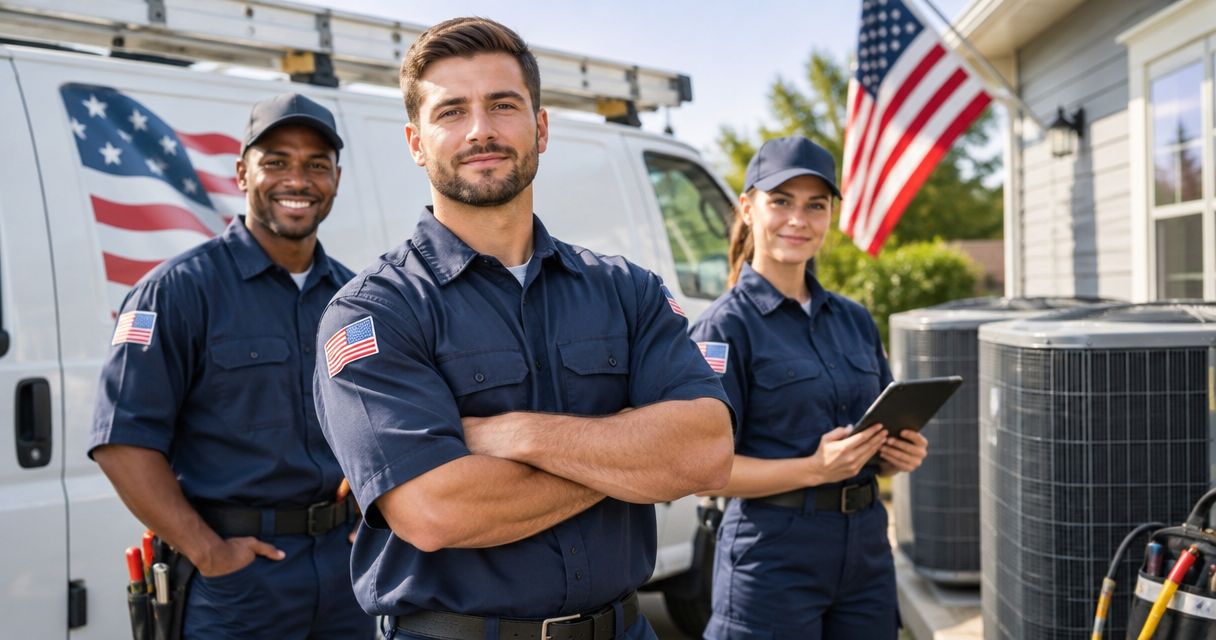
HVAC and plumbing contractors’ patriotic uniform program is a coordinated approach to work clothing with the aim of showing American pride while keeping technicians identifiable and dressed for the task. Your crew needs freedom to reach, kneel, and work around equipment—not just matching graphics. This 2026 guide puts hazard requirements, fit, and customer-facing presentation ahead of the flag print.
- Patriotic uniforms for HVAC contractors start with task requirements, not graphics; ordinary apparel does not replace required protective clothing.
- Grunt Style is best for contractors seeking ready-made patriotic apparel for non-protective uniform layers.
- Test HVAC work shirts and plumbing uniforms during actual movement before standardizing the crew’s clothing.
- Keep company identification separate from patriotic graphics, and set clear rules for customer-facing messages.
Start with the clothing your technicians already wear. Record what fits, what interferes with work, and which jobs require protective equipment before selecting Grunt Style patriotic apparel or any other everyday layer. A patriotic uniform should support the work, never redefine the safety requirements.
Why patriotic uniforms matter for HVAC and plumbing contractors
An HVAC technician’s shirt has to work during overhead reaches, equipment inspections, and customer conversations. A plumbing technician needs clothing that stays manageable while kneeling beneath fixtures and moving through tight spaces. Those tasks create different requirements from an office dress code.
Patriotic graphics give your uniform a chosen identity. They do not establish electrical protection, chemical resistance, visibility compliance, or customer trust. Keep those decisions separate: the garment must suit the task, the employee must be identifiable, and the message must match your business.
For your 2026 uniform policy, define these three responsibilities before choosing designs. A crew can share a recognizable appearance without wearing identical clothing on every assignment. Standardize the presentation; approve the clothing by role and hazard.
Build your contractor uniform program
1. Map each role to its work conditions
Begin with a free, manual review of your service schedule and existing safety assessments. List residential service, installations, shop work, and customer consultations separately. Ask technicians where their current clothing catches, restricts movement, or becomes unsuitable during a shift.
Electrical tasks, hot work, chemical exposure, and roadside work need their own clothing review. Do not approve an ordinary patriotic shirt for a hazardous task because it looks like a work shirt. Check the garment’s documented properties against the protection required by your assessment.
Create a one-page role sheet for your 2026 program. Make the approved everyday clothing and required protective equipment easy to distinguish, especially for apprentices and employees moving between assignments.
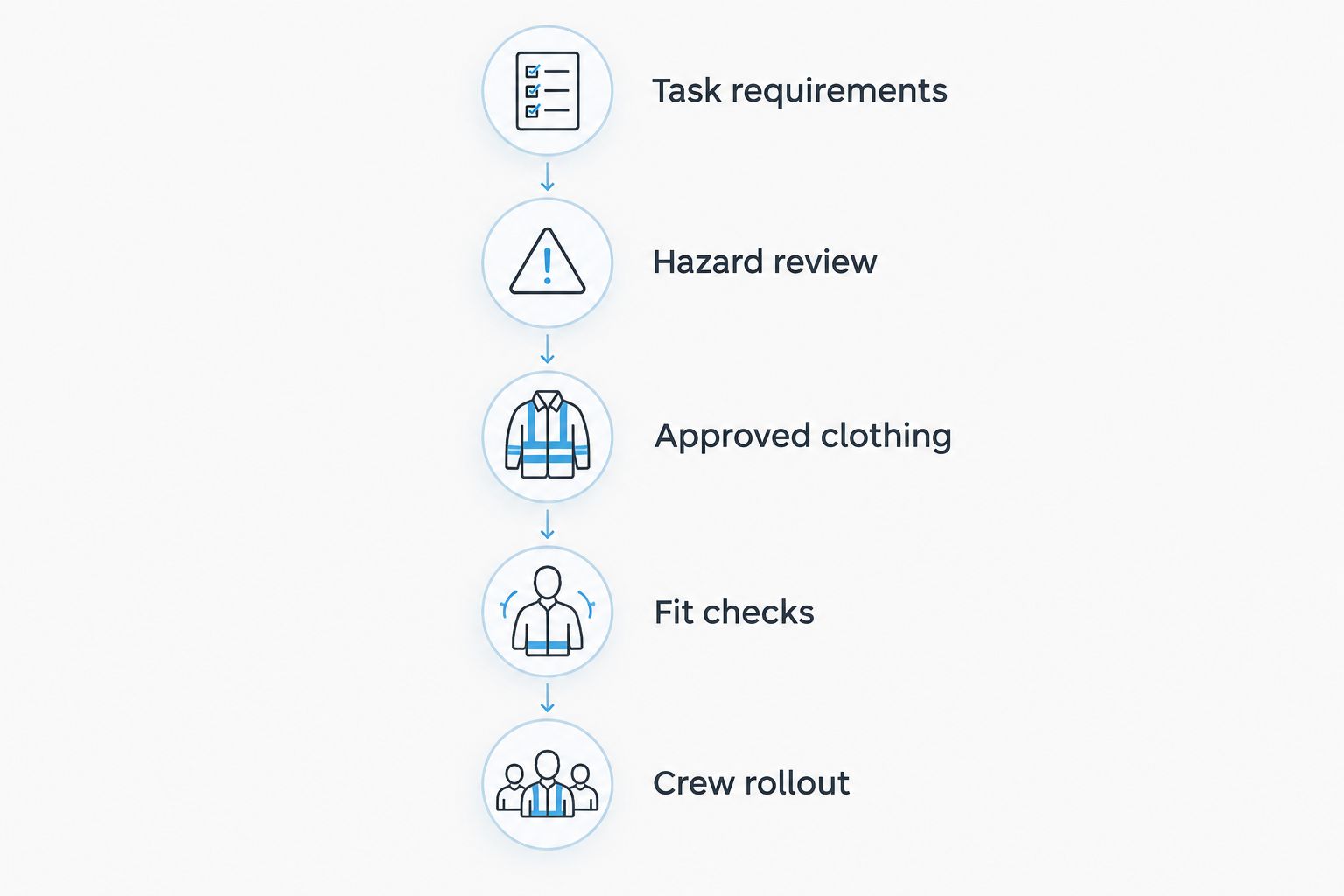
- Task requirements: Record the actual work performed in each role.
- Hazard review: Identify where everyday apparel is insufficient.
- Approved clothing: List acceptable garments for each assignment.
- Site rules: Record customer or jobsite clothing requirements.
- Replacement triggers: Define when damaged clothing leaves service.
The sequence is straightforward: establish the work requirements, check fit, then select the appearance. Purchasing comes after those decisions, not before them.
2. Test fit through real working movements
Use a shirt you already own to establish the fit your technicians need. Compare that fit with the candidate garment’s measurements and care instructions. A familiar size label is not a substitute for checking the actual cut.
Run 3 fit checks in a safe setting: an overhead reach, a kneeling position, and a seated driving position. Check the hem, shoulders, sleeves, and waistband through each movement. Perform the checks with the normal belt and approved outer layers, but away from operating machinery.
Include technicians with different body shapes in the evaluation. Do not assign women a men’s cut by default or require someone to accept restrictive clothing to preserve a matching appearance. Your uniform standard should describe the result you need, not force every employee into the same silhouette.
- Record chest and garment-length measurements.
- Check coverage during overhead reaches.
- Check sleeve movement while kneeling.
- Check comfort while seated in the service vehicle.
- Repeat the checks with approved outer layers.
3. Choose a clear patriotic presentation
Start manually: write the visual rules before shopping. Choose the color family, acceptable graphic themes, and how customers will identify the company and technician. Keep company identification readable rather than expecting a patriotic graphic to explain who arrived at the door.
Ready-made Grunt Style patriotic apparel gives you an alternative to developing an original graphic. Grunt Style is best for contractors seeking ready-made patriotic apparel for non-protective uniform layers. The limitation is equally clear: choosing a retail garment does not establish suitability for your tasks, and it does not establish that company-logo customization is offered.
Review the entire design, including the back and sleeves. A statement employees enjoy off duty does not automatically belong on a shirt worn inside a customer’s home. Approve the message for the assignment, not just the color.
- Define approved colors and graphic themes.
- Keep company identification distinct from apparel branding.
- Review front, back, and sleeve graphics.
- Separate everyday uniform choices from optional event clothing.
- Avoid branch or service claims that misrepresent an employee.
4. Assign everyday layers by task and weather
Build the basic outfit from clothing that already passes your task and fit checks. Then decide where a short-sleeve shirt, long-sleeve shirt, or removable outer layer belongs. More fabric is not automatically more protective, and fewer layers are not a heat-safety plan.
For a long-sleeve candidate, evaluate the Basic Long Sleeve - Dark Heather Gray against your crew’s movement requirements. Best for: technicians evaluating an everyday long-sleeve option where protective clothing is not required. Its limitation is that the supplied product description does not establish protective ratings or suitability for a particular trade task.
Check the candidate in ordinary, non-hazardous movements before approving it. The same fit process applies whether you prefer a basic shirt or a larger patriotic graphic.

The Freedom Gadsden Hoodie - Black is another Grunt Style option to evaluate. Best for: optional cool-weather apparel during non-hazardous activities where your rules permit a hoodie. Its limitation is the hooded design: assess loose components around equipment, and do not treat the garment as protective outerwear.
- Approve each layer for specific activities.
- Check sleeves, hems, and loose components.
- Keep required protective clothing separate from optional layers.
- Review the actual garment label and care instructions.
- Recheck fit when combining layers.


5. Pilot the uniform before the crew rollout
Use a simple paper checklist or spreadsheet to record technician feedback. Start with a small group whose assignments represent the work your crew actually performs. Include customer-facing service and installation duties rather than testing the clothing only at the shop.
Set 5 work shifts as an initial review period for your 2026 pilot. That is a planning checkpoint, not a durability claim or safety validation. Log movement problems, uncomfortable seams, interference with equipment, and concerns about the graphics.
Inspect the garments after care performed according to their labels. A shirt that works when new still needs a repeat fit check after laundering. Do not expand the order until you have resolved the problems identified in the pilot.
- Select participants across relevant roles and body shapes.
- Record feedback after each trial shift.
- Inspect seams, hems, and printed areas after care.
- Repeat the movement checks after laundering.
- Document approval or rejection for each candidate.
6. Set a practical change-and-care routine
Write the cleaning process around the garment label and the contamination involved. Normal dirt and perspiration do not call for the same response as hazardous contamination. Follow your exposure procedures rather than treating every used work shirt as ordinary household laundry.
Recommend 2 clean tops at the start of a technician’s day: the approved shirt being worn and a backup kept separate from dirty garments. This is an operating recommendation, not a universal minimum. Set the total issue quantity around your shift pattern, laundry routine, and actual replacement needs.
Keep the spare appropriate for the next assignment. An optional graphic tee cannot serve as a replacement for required protective clothing. Make changing easy without weakening the clothing rules.
- Follow each garment’s care label.
- Store clean backups separately from dirty clothing.
- Define procedures for hazardous contamination.
- Remove torn or otherwise unsuitable garments from use.
- Assign responsibility for replacement requests.
7. Publish a uniform rule your crew can use
Finish with a short written policy, not an informal instruction to wear something patriotic. Tell technicians what is approved, where exceptions apply, and who decides when a garment is unsuitable. Include the safety lead in decisions involving protective clothing.
For your 2026 rollout, photograph approved outfit combinations for internal reference. Show the everyday shirt, identification method, and permitted outer layers without implying that every combination suits every job. Keep the reference current when a garment or assignment changes.
Explain the reason for each rule. Employees should understand why one graphic is accepted for an event but not a service call, and why a hoodie belongs in some activities but not others.
- List approved outfit combinations by role.
- State when required protective clothing takes priority.
- Identify who approves exceptions.
- Explain customer-facing graphic restrictions.
- Record the process for changing the uniform standard.
Compare uniform options by assignment
The best option is the one that meets the assignment’s requirements. Use this comparison to separate everyday presentation from protection. Do not compare a graphic shirt and a rated protective garment as interchangeable alternatives.
| Option | Best for | Main advantage | Key limitation |
|---|---|---|---|
| Patriotic short-sleeve tee | Approved non-hazardous everyday assignments | Straightforward patriotic presentation | A graphic does not establish protective performance |
| Basic Long Sleeve - Dark Heather Gray | Evaluating an everyday long-sleeve uniform | A named long-sleeve candidate for your fit trial | Protective ratings are not established by the supplied description |
| Freedom Gadsden Hoodie - Black | Optional cool-weather, non-hazardous activities | Combines a hooded layer with a patriotic theme | Loose components need assessment; it is not established as protective clothing |
| Company-identified polo or work shirt | Consultations and roles needing clear business identification | Makes identification part of the uniform plan | Fabric, fit, decoration, and task suitability still require evaluation |
| Task-rated protective clothing | Assignments requiring documented protection | Addresses the protection specified by the hazard assessment | Selection and decoration must preserve the required performance |
Do not assume any supplier offers the polo, customization, or protective clothing described here. Those rows describe uniform approaches, not verified services from a particular brand. Ask for garment documentation before approving a protective claim, and confirm decoration requirements before altering rated clothing.
Common mistakes HVAC and plumbing contractors make
Treating patriotic graphics as proof of protection
A flag, military theme, or rugged product description is not a protective rating. Approve protection from documentation, not appearance. Bright colors also do not establish that a garment meets a visibility requirement.
Choosing the shirt before the work requirements
A favorite graphic is a poor starting point for a crew working across electrical equipment, installations, and customer consultations. Start with the role sheet, then narrow the designs to garments that pass the relevant checks.
Requiring identical fit across the crew
Matching size labels do not establish matching fit. Give employees a way to report restricted movement and test appropriate cuts without treating fit concerns as a failure to follow the uniform policy.
Losing company identification under the outer layer
A coordinated shirt does little for identification when an outer layer covers the identifying information. Check the complete outfit used at the customer’s door. Provide a separate identification method when the approved layer hides it.
Approving messages without reading the whole garment
Review every printed surface, not just the thumbnail image. Do not assume a homeowner shares an employee’s sense of humor, military background, or preferred slogans. Keep service-call graphics aligned with the business’s written standard.
FAQ
What are the best patriotic uniforms for HVAC contractors?
The best patriotic uniforms for HVAC contractors meet task requirements first and add patriotic graphics only to approved garments. For everyday non-protective layers, evaluate fit, movement, identification, and the message before approving a design.
Can plumbing contractors use patriotic T-shirts as uniforms?
Plumbing contractors can include patriotic T-shirts in a uniform program for assignments where the garments meet the assessed clothing requirements. A T-shirt does not replace protective clothing required for a particular exposure or task.
Is Grunt Style suitable for contractor uniforms?
Grunt Style is a candidate for ready-made patriotic everyday apparel, not a substitute for documented protective clothing. Evaluate each garment against your contractor uniform policy and confirm company identification separately.
Are patriotic hoodies appropriate for HVAC technicians?
Patriotic hoodies belong only in activities where the employer’s clothing rules and hazard assessment permit them. Assess hoods and other loose components around equipment, and do not assume a hoodie provides protective performance.
How do I choose sizes for an HVAC or plumbing crew?
Choose sizes using garment measurements and individual movement checks rather than a shared size-label assumption. Check overhead reach, kneeling, and seated driving positions with the approved outfit combinations.
Should contractor uniforms include military branch graphics?
Use military branch graphics only when they fit your business policy and do not misrepresent the wearer’s service. Give employees an approved option that does not imply a military background.
Can I add a company logo to protective work clothing?
Add a company logo to protective clothing only through a decoration method approved for that garment and its required performance. Confirm the manufacturer’s requirements before adding patches, embroidery, or printing.
One last thing
A patriotic shirt is not the same thing as company identification. Before approving your 2026 uniform, stand at the doorway with a technician wearing the complete outfit. Check that the customer can identify the business, that outer layers do not obscure essential identification, and that the technician can move comfortably. Fix those details before expanding the program.